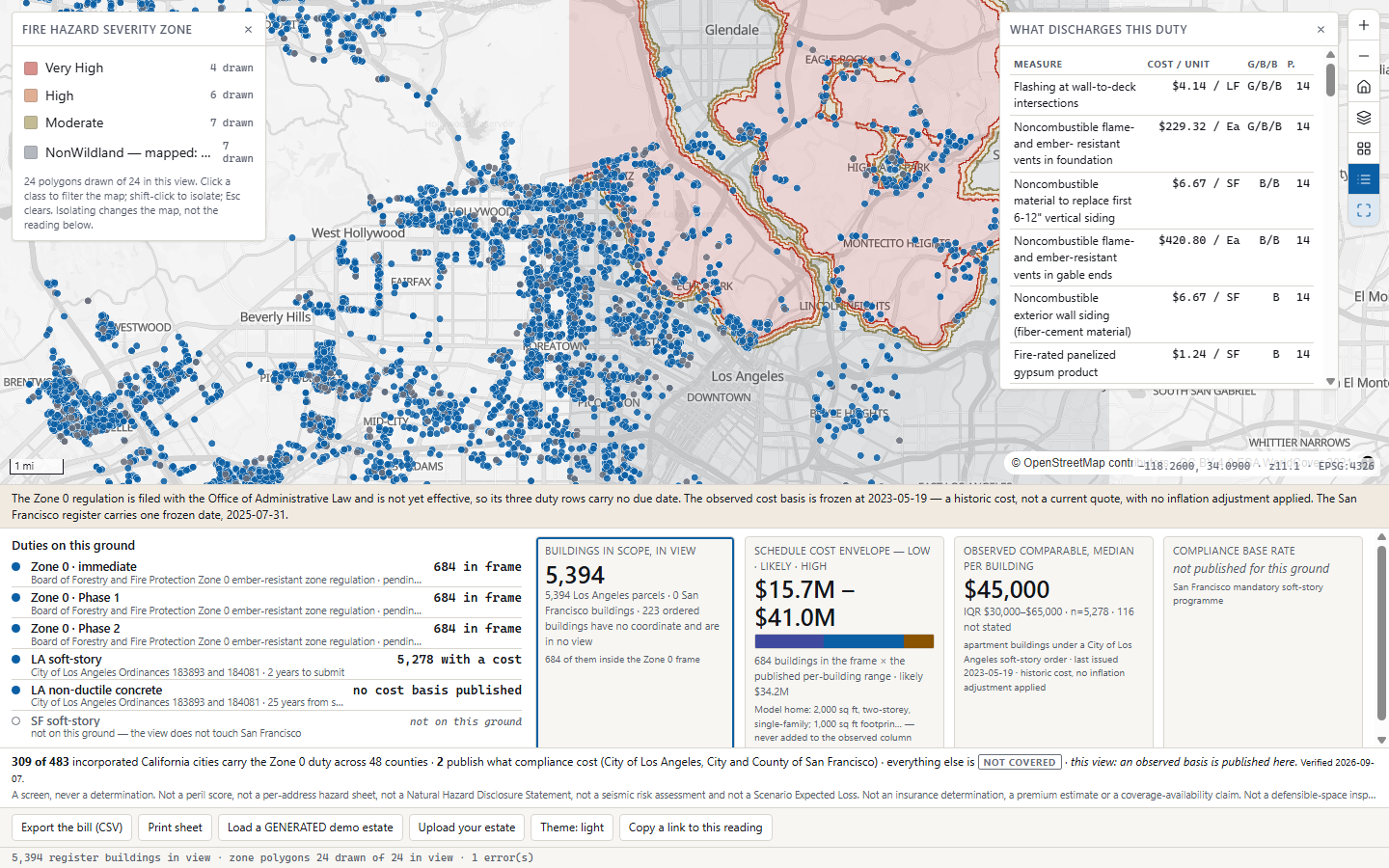
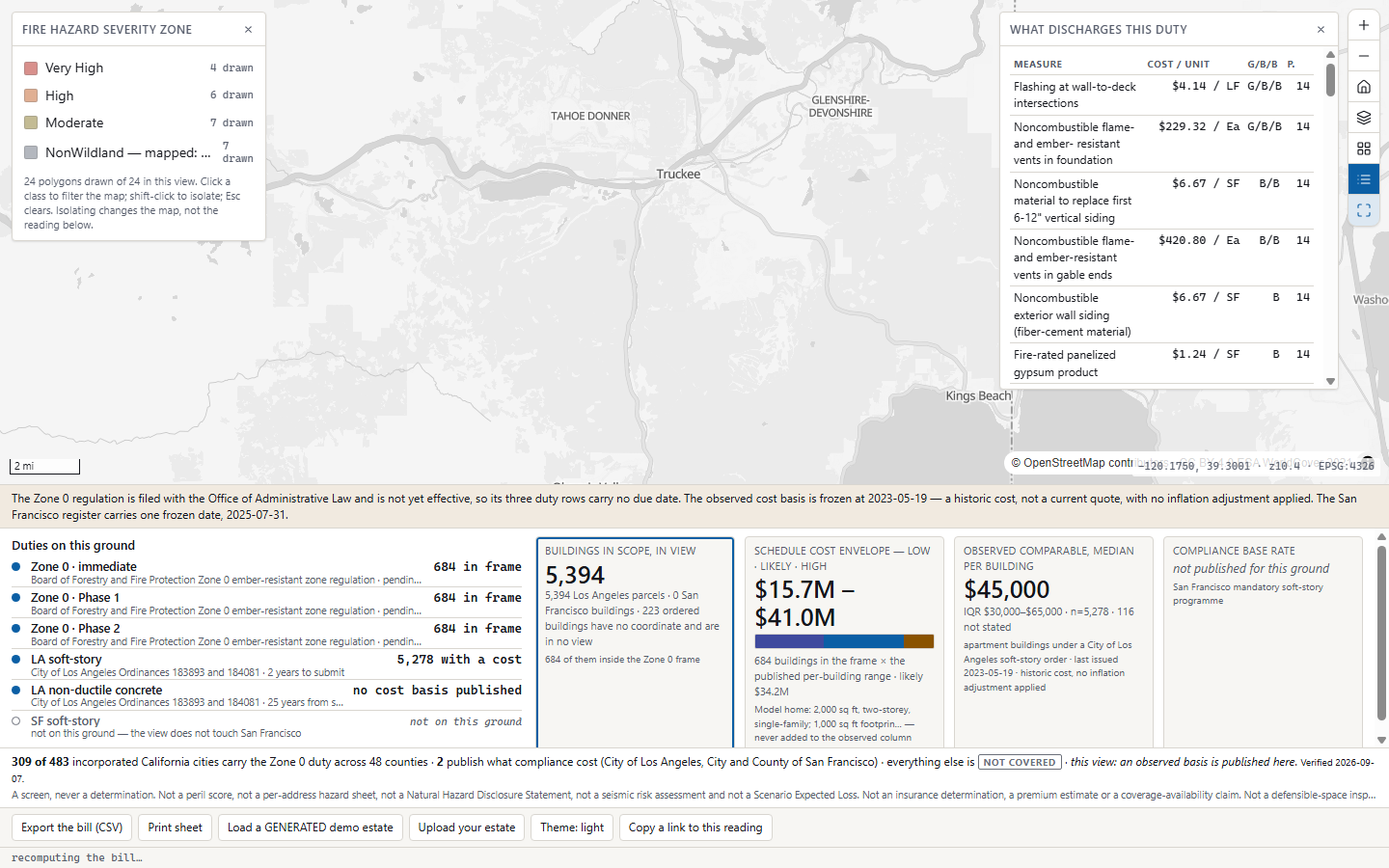
California has adopted a new wildfire rule that reaches roughly 1.75 million buildings. The state did not say what it costs to comply. This app estimates that cost from public data, and shows what owners actually paid for a similar retrofit rule.
A retrofit duty is a legal requirement to upgrade a building by a set date. The owner cannot opt out. What the owner can decide is the order, the timing, and whether to keep the building at all.
That makes it a budget question. Which buildings go into next year's capital plan? And where is the cost of complying so high that selling makes more sense?
Zone 0 is the first five feet around a building, which must be kept free of things that catch fire from embers. The Board of Forestry's summary of the rule gives no building count and no cost. The only figures around are anecdotes: one councilmember quoted about $13,000 per property, and fencing contractors quote $5,000 to $15,000.
An owner of several buildings has nothing to budget against. Some insurers now offer 10 to 15% off premiums for documented compliance, so the cost also affects returns.
| Product | What it gives you | Sold to | Shows the cost to comply? |
|---|---|---|---|
| Verisk FireLine | a 0–30 wildfire risk score | insurers | No |
| ZestyAI Z-FIRE | a property risk score from aerial imagery | insurers | No |
| Cotality US Wildfire Model | a property risk score used in insurance pricing | insurers | No |
| Munich Re Location Risk Intelligence | expected losses, plus some retrofit suggestions | owners | No, the closest alternative |
| MSCI physical risk · First Street | loss estimates across many hazards | investors | No |
| The Compliance Bill | a cost range for each legal duty, plus what owners actually paid | owners | Yes, from public data |
These products tell you how exposed a building is. They do not tell you what a specific required upgrade will cost. Their models are also closed, so you cannot check the workings.
Products reviewed on 2026-09-07.
You do not pick your obligations. Where the building stands decides them. So you simply move the map to your buildings.
A soft-story building has a weak ground floor, such as open parking under apartments. When a rule does not apply, the app says why. It never shows it as $0.
Filled dot and a building count. The count uses the official zone boundaries at full detail.
Grey hollow dot, with the reason in words. That is a fact about the location, not missing data.
Marked NOT COVERED. Of 483 California cities, 309 have the Zone 0 duty. Only two publish what compliance cost. Elsewhere you get the estimate only.
Each state also has a label or symbol, so colour is never the only signal. Where a permit lists no real cost, the app shows not stated, not $0. That is true of 2,773 of the 13,277 Los Angeles permits (20.9%).
13,277 Los Angeles soft-story retrofit permits, each with the declared construction value. 10,504 list a usable figure. The average is $53,338.
San Francisco's list of 4,945 buildings ordered to retrofit, with each one's status. LA shows who did the work. SF shows everyone who had to.
53 priced upgrade measures from a cost study by Headwaters Economics, funded by CAL FIRE and based on the California Building Code wildfire chapter.
Zone 0 Phase 1 requires flammable mulch to be removed from the first five feet. The study prices the replacement at $463.62 per cubic yard. Phase 2 requires a non-combustible fence section where a fence meets the building. The study prices that at $60.44 per square foot.
The cost study is based on a two-storey house. The LA permits are almost all apartment buildings (98.7%). The app shows the two side by side and never adds them together.
Upload your building list as a spreadsheet (CSV) or map file (GeoJSON). The file stays on your computer. The app then shows which rules apply to your buildings and what they are likely to cost.
The fire zones, the list of rules and the cost table are separate settings. That means the app can be set up for another city or country without rebuilding it.